Executive Summary
A cloud & AI spend financial control plane is the system finance, engineering, and IT share to tie every dollar of cloud and AI spend to a business outcome in real time — and to govern it while the spend is happening, not after the invoice lands.
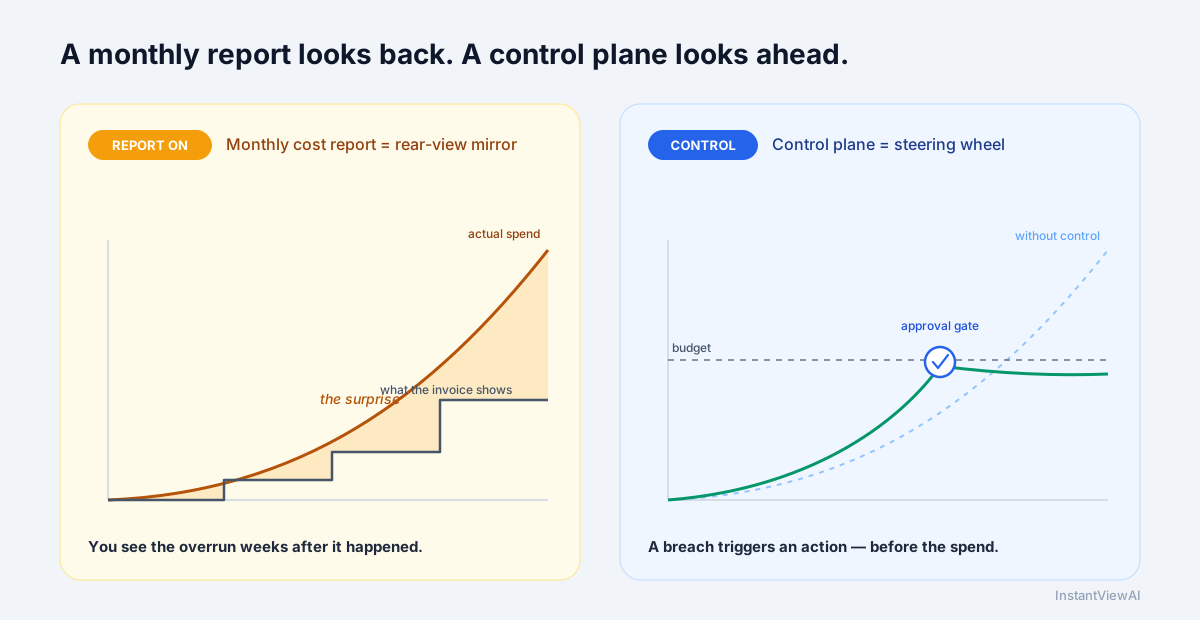
For years, finance ran cloud the way it runs the phone bill: wait for the statement, absorb the surprises, argue about them next month. AI killed that. Spend now accrues by the token and the GPU-hour, and a single weekend can swing the number by six figures. A monthly cost report, in that world, is a rear-view mirror bolted to a car that keeps accelerating.
The control plane is the steering wheel. It pulls in usage and billing from every provider as it happens, assigns all of it — not most of it — to the products, customers, and features that caused it, holds spend against budgets and policy before it commits, and leaves an audit trail the board and the auditors will actually accept. Cloud and AI stop being a number you explain after the fact and become one you steer.
This piece does three things: it names the category, explains why it suddenly matters, and hands you a model — the Financial Control Plane Stack — for judging any control plane, bought or built. It is written for the CFO who has been asked for the return on a year of AI spend and has no instrument that can answer.
In one sentence: a cloud & AI spend financial control plane ties every dollar of cloud and AI spend to a business outcome in real time, and governs that spend before it gets away from you.
Definition
A cloud & AI spend financial control plane is a single place that takes in cost and usage from every cloud and AI source and runs one consistent financial logic over it, live — assigning each dollar to a business outcome and catching it before the invoice ever prints.
The name is borrowed, on purpose, from networking. A network's control plane decides where traffic goes; a separate data plane moves it. A financial control plane does the control-plane job for money. It doesn't run your workloads. It governs how cost and value move through the company.
Three things set it apart from the tools before it:
- It's live, not a month-end batch. It reads usage and billing at the speed they're generated, not on a closing calendar.
- It attributes, not just totals. Every cost lands on a specific owner — a product, a customer, a team — as it arrives, so nothing sits in a pool marked "miscellaneous."
- It intervenes, not just reports. It is built to stop an overrun, not narrate one after payday.
It covers the lot — the big clouds (AWS, Azure, GCP, OCI), the AI providers (OpenAI, Anthropic, and the rest), and the familiar finance work of budgeting, forecasting, and chargeback — but always pointed at control rather than record-keeping.
One thing it is not: a cost-cutting tool. Trimming the bill isn't the job. The job is accountability — making spend predictable, traceable, and defensible. If money gets saved along the way, good. That's a side effect, not the pitch.
Why It Exists
AI broke the monthly bill
Old-school cloud cost management assumes you can wait for the invoice and sort it out later. AI ended that. Inference and training rack up by the token and the GPU-hour, they spike the moment a feature catches on, and they attach to model endpoints nobody assigned to a cost center in advance. By the time the bill arrives, the decision that blew the budget is three weeks cold and the money is gone.
The ROI gap landed on the CFO's desk
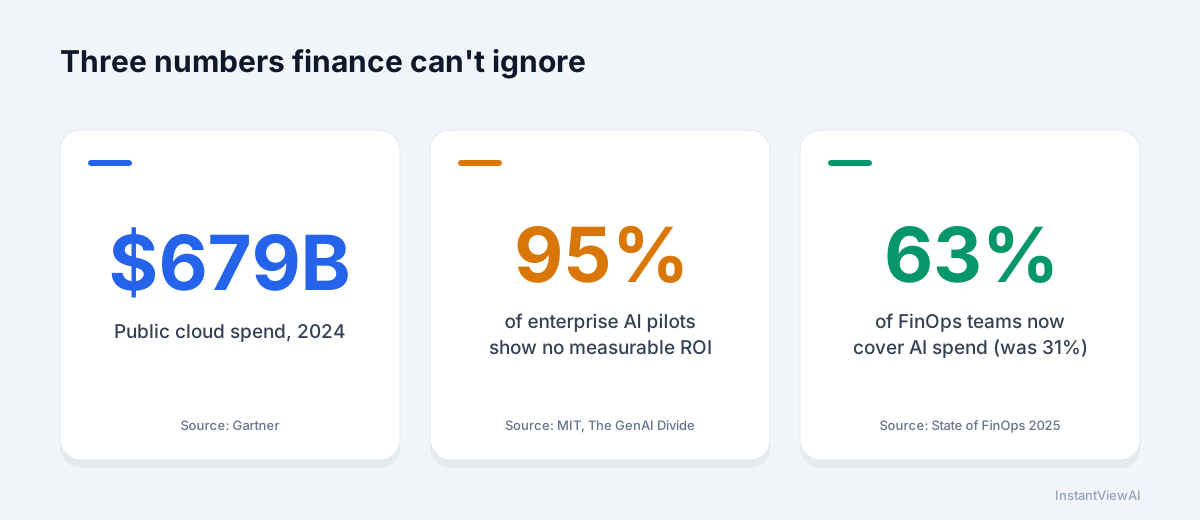
The numbers are unforgiving. Around 14% of CFOs say they can point to clear, measurable ROI from their AI investments [1]; an MIT study put 95% of enterprise AI pilots at no measurable return [2], a shortfall since sized at roughly $600 billion in spend nobody can yet justify [2]. That's not a model problem. It's a governance problem — companies spending faster than they can attribute, attributing slower than they decide.
Which lands it on the CFO. Deloitte now casts CFOs as capital-allocation strategists on the front line of AI, holding AI budgets to the same standard as ERP or headcount [3]. The awkward part: when the board asks for the ROI, most finance leaders don't have the data plumbing to answer [4]. One investor's framing for the year ahead — 2026 is AI's "show me the money" year [13]. The control plane is what makes an answer possible.
The market already voted
This isn't a concept waiting for buy-in. FinOps — finance, engineering, and product managing cloud spend together — is effectively standard at scale: 9 of the Fortune 10 and 43 of the Fortune 50 run an active practice [7]. And it's moving straight at this problem. In 2025, 63% of organizations said their FinOps practice now covers AI spend, up from 31% a year earlier [6].
The scale is the reason for the urgency. Public cloud spending hit about $679 billion in 2024 and grew north of 20% year over year [9], with AI loading the curve further. When your fastest-growing line item is also your least predictable, "wait for the invoice" isn't a plan.
From optimization to control
There's a deeper reason the category exists: the goal changed. First-generation tools chased optimization — rightsize the instance, buy the reservation, kill the idle box. Useful, but it's cleanup, and you can only optimize what's already running. A control plane is about decision control. It moves the moment of intervention upstream — to when a budget is set, a workload approved, a model shipped. Optimization asks how to shave last month's bill. Control asks whether the spend should happen at all, and whose name is on it. The second question is the one a CFO actually loses sleep over.
Core Components: The Financial Control Plane Stack
Plenty of tools deliver one or two of the capabilities below and call themselves a control plane. The real thing needs all four, and they only work bottom-up. We call the model the Financial Control Plane Stack — the lens we use to define the category and to size up any control plane, whether you buy one or build it.
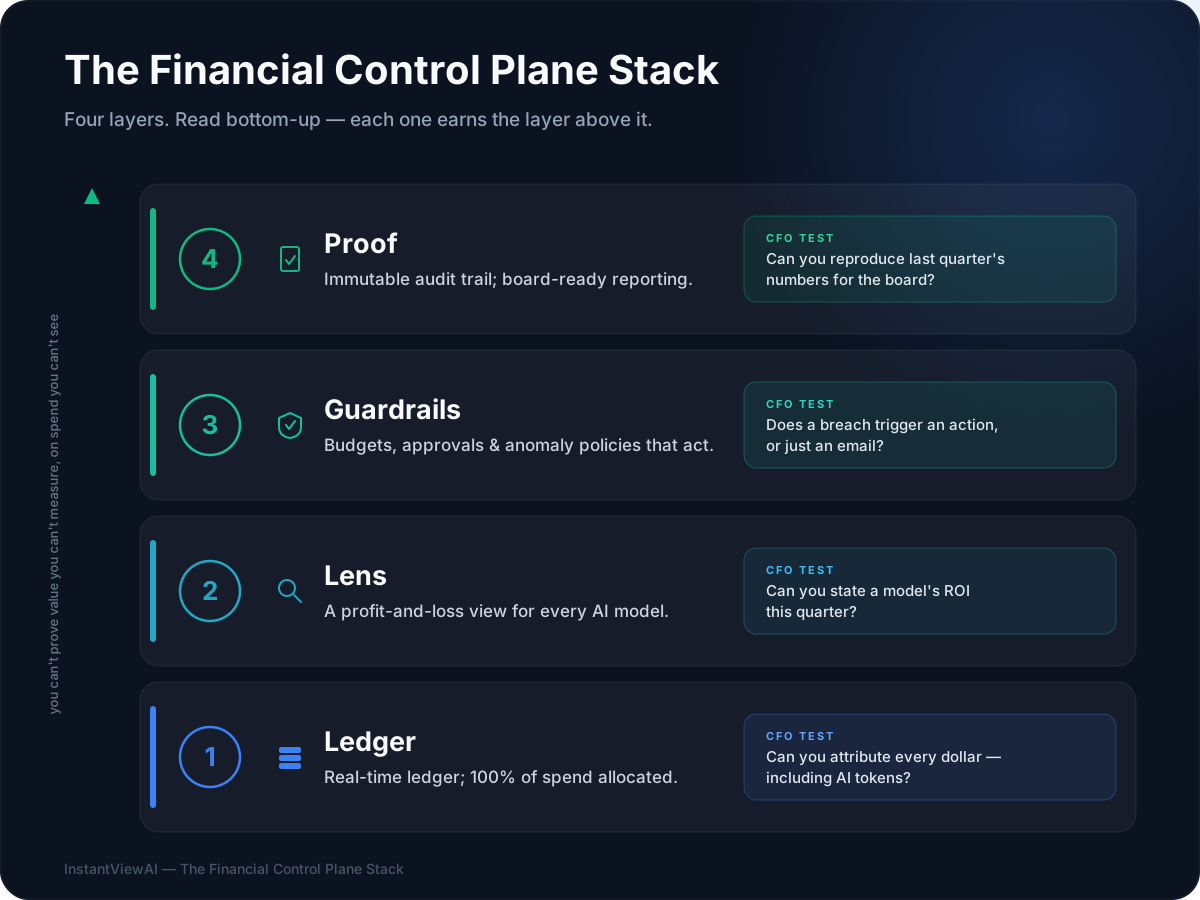
Read it from the floor up. You can't prove value you can't measure, and you can't measure spend you can't see. Each layer is a question a CFO can put to a vendor and check the answer.
Layer 1 — Ledger: see it all, attribute it all
The base is a live, unified ledger of every cloud and AI dollar, with 100% of it pinned to a business owner — product, customer, feature, team. The number that matters is unallocated cost: the share the system still can't pin on anyone. A good Ledger drives that toward zero, including the hard cases — shared infrastructure, and AI tokens that have to be traced from a model endpoint back to the request that fired them.
The CFO test: can you put a name to every dollar — shared infrastructure and AI tokens included?
Under the hood: continuous multi-cloud ingestion, normalized through a shared model like the FinOps FOCUS spec [8]; rule-based attribution that reaches the resources nobody labeled; and unallocated cost tracked out in the open, where it can't hide.
Layer 2 — Lens: turn cost into value
A ledger tells you where the money went. The Lens tells you whether it was worth it. This layer maps spend onto outcomes — cost per customer, cost per feature, and the one most teams are missing, a P&L for each AI model. It's where "spend" becomes "investment." Get it right and finance can say what a given model cost, what it produced, and whether the trade was good [1]. CFOs care about unit economics, not a bigger pile of cost cuts [10].
The CFO test: can you tell me a specific model's ROI this quarter?
Layer 3 — Guardrails: stop it before it spends
This is the layer that earns the word control. Everything below it watches; Guardrails act — holding budgets hard and soft, routing the big calls through approval, enforcing policy, and flagging anomalies while there's still time to do something. The test is blunt: when a budget breaks, does anything actually happen, or does someone just get an email? A real control plane closes the loop — reconciles budgets, catches anomalies in hours, attributes cost at the moment of provisioning [10].
The CFO test: does a budget breach trigger an action, or a notification?
Layer 4 — Proof: make it defensible
The top layer makes the whole thing auditable — an immutable trail of every allocation and policy call, cost models versioned so you can reconstruct how spend was structured on any past date, and reporting a board will sit still for. This is what lets a CFO face an auditor, or a restless board, and show exactly how cloud and AI hit the P&L two quarters ago — and prove no one quietly rewrote it since.
The CFO test: can you reproduce, and defend, how costs hit the P&L last quarter?
Why the order matters
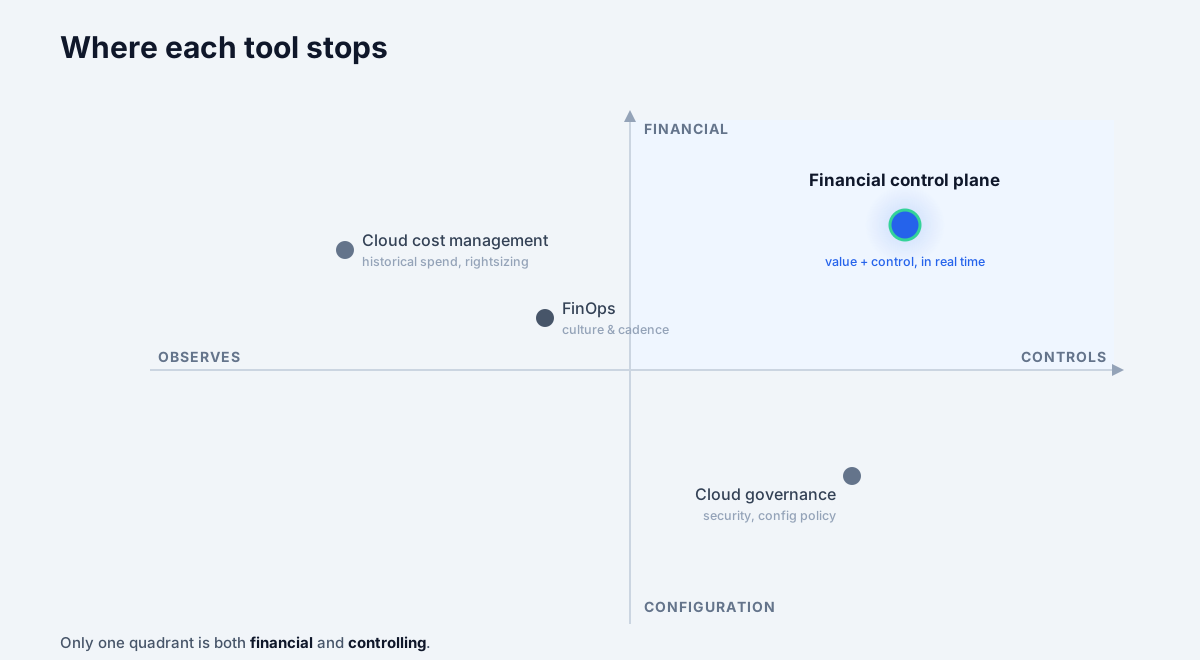
The sequence isn't decorative. Most optimization tools and FinOps dashboards stop at Layers 1–2 — they see, they sometimes value, but they don't enforce. Governance tools start at Layer 3, enforcing policy on numbers they can't fully attribute because there's no Ledger underneath. The control plane is what holds all four together. So when you weigh a vendor or scope a build, ask which layers it really delivers — and whether it skipped the foundation and hoped you wouldn't notice.
How It Works
A control plane runs as a loop. Walking the path the data takes is the easiest way to see it.
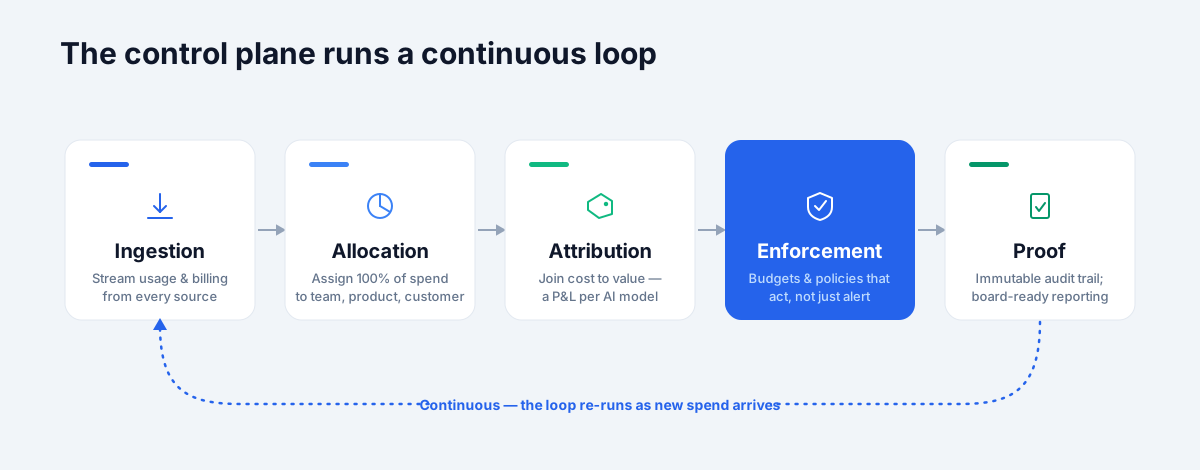
1. Ingestion. Usage and billing pour in from everywhere — hyperscaler billing exports and APIs, Kubernetes and container telemetry, SaaS subscriptions, AI usage logs counted in tokens, GPU-hours, and API calls. The formats don't agree, so the control plane normalizes them into one model, often on the FinOps FOCUS standard, and an AWS line and an OpenAI charge finally sit in the same ledger [8].
2. Allocation. Each cost is assigned to an owner — product, team, customer — as it arrives. Where the providers' own labels exist, they do the easy work; rule-based attribution (say, deriving an owner from a resource's metadata) covers what shows up unlabeled and splits the shared costs. Whatever still can't be placed is surfaced as unallocated cost, not quietly smeared across everyone.
3. Attribution. Allocated cost gets joined to usage and business data so each dollar carries context — GPU spend on a model tied to the features it served or the revenue it earned, instead of sitting as one more anonymous infrastructure charge [5].
4. Enforcement. Against that live picture the policy engine runs without stopping — checking budgets, updating forecasts, weighing approval thresholds, flagging anomalies. Trip a policy and the system does something: alerts the owner, demands an approval, blocks the provisioning call. That's the "control" in control plane [10].
5. Proof. Every allocation, policy call, and model change is written to an immutable trail, and the cost models behind attribution are versioned. From there finance produces forecasts, board decks, and audit packages that reproduce exactly.
For the CFO, the four classic finance jobs change shape:
- Budgeting and forecasting move off the static annual plan to rolling, scenario-based forecasts that alert on drift [11].
- Chargeback and showback run themselves, allocating by rule or hierarchy so engineering owns its budget and shadow spend surfaces instead of hiding [11].
- Compliance and audit become continuous — a standing trail from every dollar back to the P&L.
- Cost versus value turns into something measurable. The org can report return, not just burn.
Worth keeping: a control plane doesn't make cloud cheaper. It makes cloud accountable.
Common Mistakes
The category is real. So are the ways it goes wrong — and naming them is the difference between buying a control plane and buying a costlier report.
Mistaking a dashboard for control. The classic error: assuming that seeing waste equals stopping it. A dashboard that surfaces waste but changes no behavior is, in one practitioner's phrase, "cost-control theater" [12]. The critics have the diagnosis right — reporting without action is theater — though most of them prescribe more automated optimization, which is half a step; it only trims what already ran. The real fix is governance wired into execution: deciding what's allowed, and whose it is, before it happens. If a breach produces a chart instead of a consequence, you're at Layer 1, not a control plane.
Expecting it to replace re-architecture. A control plane governs spend; it doesn't redraw your systems. The big savings still come from engineering — re-architecting workloads, not staring at dashboards. As one FinOps lead put it, the real money is in "finding inefficiencies within the organization's infrastructure — which most FinOps tools will not be able to advise on" [7]. Let the control plane make those decisions visible and accountable; don't expect it to make them for you.
Attribution you can't stand behind. The whole stack rests on attribution, and attribution is only as good as the data under it. When resources arrive unlabeled or labeled inconsistently, cost lands in the wrong place or in no one's, and finance ends up defending numbers it can't fully trust [11]. The answer is to make rules, not hand-typed labels, the source of truth for who owns what — and enforce them as spend is created, so coverage climbs toward 100% without a cleanup that never ends.
Underrating change management. A control plane spans finance, engineering, and the business, and it changes who's accountable for what. Without a senior sponsor it stalls; young FinOps practices "often get stuck battling other priorities" without backing [7]. Pilot it where someone actually wants it, prove the value, expand from there.
Confusing optimization with governance. The costliest strategic miss: buying a control plane to shave next month's bill. That's optimization, and it's bounded. A control plane earns its keep by making spend predictable, attributable, and defensible over time. Grade it on this quarter's discount and you'll both undervalue and misuse it.
Centralizing sensitive data with no security plan. Pulling billing, usage, and business data into one system raises fair questions about access, residency, and audit. Treat the control plane as the financial system of record it is, with the controls that implies.
Examples
A control plane in action: the AI-model P&L
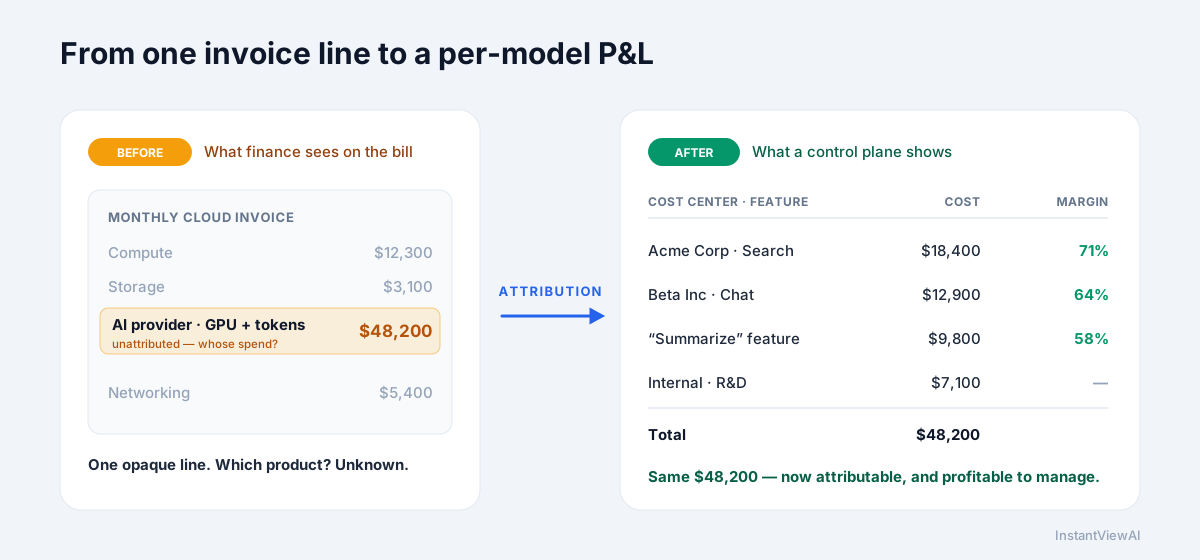
The cleanest example is the problem that created the category. A team ships an AI feature on a large language model. With no control plane, the cost shows up at month-end as one fat line on the provider's bill — big, growing, unattributable. With one, the GPU and token spend is traced the instant it's used back to the customers and features that triggered it, and you get a per-model P&L. CloudZero built its product around exactly that move — spend tied to specific customers and features at the point of use [1]. The finance question flips from "why is the AI bill so high?" to "which customers are profitable on this model, and at what margin?"
Splitting shared cost fairly
A platform team runs infrastructure that a dozen product teams use. The Ledger splits that shared cost by usage and rule, so each product carries its true loaded cost instead of the platform team eating it as overhead. Teams that suddenly see their real numbers tend to behave differently — that's the accountability dividend, and it isn't a discount.
A budget that does something
A finance owner sets a hard budget on a new AI workload. As forecast usage approaches the line, the Guardrails layer doesn't email a report — it routes the provisioning request into approval and pings the owner. The overrun is stopped before it happens. That, in one moment, is the gap between a control plane and a cost report.
The vendor landscape (a sample, not a census)
The field runs from established FinOps platforms to finance-first newcomers. Apptio Cloudability and VMware CloudHealth lead with budgeting, multi-cloud reporting, and rightsizing. Real-time-attribution specialists like CloudZero focus on tying spend to customers and features. Kubecost goes container-native, costing Kubernetes down to the namespace and pod. And a newer, CFO-facing class — Ternary among them, pitching an end-to-end ledger for cloud, SaaS, and AI by cost center with ERP integration — aims straight at the finance office [4]. The hyperscalers ship their own controls too (AWS Cost Explorer, Azure Cost Management), usually strong inside their own cloud and thin across providers and on AI attribution. Hold any of them up to the four layers: how deep does it go, and where does it stop?
A note on InstantViewAI. The Financial Control Plane Stack is InstantViewAI's model, and InstantViewAI is built to deliver all four layers across cloud and AI spend together, not AI alone: real-time cost allocation that reaches even unlabeled and shared spend, via rule-based virtual tags (Ledger); versioned cost models and unit economics (Lens); a budgeting and approval-workflow engine (Guardrails); and an immutable audit trail (Proof). It is a cloud & AI spend financial control plane built around governance and decision control — predictable, accountable, and defensible — not AI-cost reporting or discount-hunting. One example of where the category is going; the Stack is how to judge the rest.
Related Concepts
A control plane doesn't stand alone. The fastest way to see what's new about it is to place it next to the things it isn't.
| Concept | Focuses on | When it acts | Primary user | How it relates to the control plane |
|---|---|---|---|---|
| Cloud cost management | Historical spend, rightsizing, reservations | After the invoice | Engineering / FinOps | The predecessor — good at optimization, but it watches rather than acts |
| FinOps | Culture and cross-functional accountability | Monthly / quarterly | Finance + engineering + product | The practice; the control plane is the engine that runs it in real time |
| Cloud governance | Security, compliance, config policy | At deploy time | Platform / security | Complementary — it governs configuration; the control plane governs financial behavior |
| Financial control plane | Value attribution and financial control | Real time / at provisioning | Finance + engineering | The layer that ties the rest together and adds enforcement and value |
A few worth a sentence more:
FinOps vs. the control plane. FinOps is people and process agreeing to manage spend together. The control plane is the technology that lets them do it continuously instead of once a month — the framework sets the metrics, the engine enforces them live [10].
Cost management vs. the control plane. Cost tools flag the spike after you've been billed. A control plane catches it as it happens, business context attached, before the charge lands.
Governance vs. the control plane. Governance checks that resources are configured right — encryption, identity, tagging policy. A control plane checks that spending is right — budgets, approvals, ROI. They sit side by side.
Unit economics, showback/chargeback, FOCUS. The raw materials a control plane operationalizes: unit economics is the Lens layer's language, showback/chargeback is what Ledger plus Guardrails automate, and the FinOps FOCUS spec is the open standard that keeps the Ledger from locking you to one vendor [8].
For more, see the companion pieces on AI spend governance, cloud unit economics, and the cloud financial governance maturity model.
FAQ
What is a cloud & AI spend financial control plane? It's a real-time system of record that ties every dollar of cloud and AI spend to a business outcome and governs that spend as it happens — budgets, approvals, and anomaly checks up front — instead of explaining it once the invoice arrives.
How is it different from FinOps? FinOps is the practice — people and process managing cloud spend together. A control plane is the technology that runs that practice continuously. FinOps sets the metrics and the culture; the control plane enforces them in real time, at the point of provisioning, rather than in a monthly review.
Is it the same as a cloud cost management tool? No. Cost management tools look back at what you've spent and suggest savings. A control plane acts in the moment — attributing cost as it's incurred and holding spend to budget and policy before money moves. Observation versus control.
Why do CFOs need one specifically for AI spend? Because AI cost behaves differently: it accrues by the token and the GPU-hour, spikes with usage, and maps to no cost center you set up in advance, so it's invisible until the bill shows up. With roughly 14% of CFOs able to point to clear AI ROI, a control plane is the plumbing that lets finance tie that spend to outcomes and answer the board [1].
Does it reduce cloud costs? Often — but that's the side effect, not the point. A control plane is built to make spend accountable: predictable, attributable, defensible. Savings follow from the accountability. Buy it purely as a discount engine and you'll misuse it.
What are the layers? Four, bottom-up: Ledger (see and attribute all spend), Lens (turn cost into value and unit economics), Guardrails (enforce budgets, approvals, anomaly policy), and Proof (immutable audit trail and reproducible, board-ready reporting).
How long does it take to implement? A focused pilot on one high-spend product or AI workload stands up in weeks; enterprise rollout runs to months. The path that works is to go deep on a narrow slice first, then widen — not boil the ocean.
What KPIs show it's working? Unallocated-cost percentage (heading toward zero), forecast accuracy (how far prediction drifts from actuals), attribution coverage, budget variance, time-to-report, and a spend-to-value ratio that ties cloud and AI dollars to business outcomes [11].
Sources
- CloudZero, "CloudZero, The AI ROI Company, Launches the Financial Control Plane for AI," PR Newswire, May 28 2026. https://www.prnewswire.com/news-releases/cloudzero-the-ai-roi-company-launches-the-financial-control-plane-for-ai-302784605.html — real-time AI outcome attribution, tying GPU and token spend to customers and features; ~14% of CFOs report clear AI ROI; cited as a category example.
- MIT / Project NANDA, "The GenAI Divide: State of AI in Business 2025" — 95% of enterprise AI pilots deliver no measurable ROI; ~$600B AI ROI gap. Coverage: Fortune, https://fortune.com/2025/08/18/mit-report-95-percent-generative-ai-pilots-at-companies-failing-cfo/.
- Deloitte, "CFO Insights for AI: Cost, Risk, and ROI." https://www.deloitte.com/us/en/programs/chief-financial-officer/articles/cfo-insights-ai-cost-risk-roi.html — CFOs as capital-allocation strategists applying ERP-grade rigor to AI budgets.
- Ternary, "Technology investment intelligence for Finance" (homepage). https://ternary.app/ — CFO-centric technology ledger unifying cloud, SaaS, and AI spend by cost center; source of the "The board asks for AI ROI. I have no data infrastructure to answer." framing.
- Deloitte, "AI token economics for CFOs." https://www.deloitte.com/us/en/services/consulting/articles/cfo-guide-ai-token-economics.html — governing AI token spend and per-model P&L context.
- FinOps Foundation, "The State of FinOps 2025 Report." https://data.finops.org/2025-report/ — 63% of organizations now manage AI spend within FinOps, up from 31%.
- CFO.com, "FinOps: A Way to Manage Growing Cloud Costs" (featuring J.R. Storment, FinOps Foundation). https://www.cfo.com/news/finops-a-way-to-manage-growing-cloud-costs/654716/ — 9 of the Fortune 10 / 43 of the Fortune 50; 60–80% building FinOps teams; the Tealium "savings come from finding inefficiencies" quote; FinOps stalls without executive sponsorship.
- FinOps Foundation, "FOCUS — FinOps Open Cost & Usage Specification." https://focus.finops.org/ — vendor-neutral common data model for normalizing cloud, SaaS, and AI billing data.
- Gartner, "Gartner Forecasts Worldwide Public Cloud End-User Spending to Reach $679 Billion in 2024," Nov 13 2023. https://www.gartner.com/en/newsroom/press-releases/11-13-2023-gartner-forecasts-worldwide-public-cloud-end-user-spending-to-reach-679-billion-in-20240 — ~$679B public cloud spend in 2024, growing ~20% YoY.
- DigiUsher, "AI Cost Governance: How to Prevent Runaway GenAI Spend." https://www.digiusher.com/blog/ai-cost-governance-how-to-prevent-runaway-genai-spend/ — real-time control loop with cost attribution and mandatory tagging enforced at provisioning; CFO focus on unit economics.
- KPMG, "As cloud over-spending rises, look to cost optimization." https://kpmg.com/xx/en/our-insights/transformation/cloud-cost-optimization.html — tagging compliance as a core KPI, rolling forecasts with deviation alerts, chargeback by tag/hierarchy, and TCO/spend-to-value metrics. See also KPMG, "Taking control of cloud costs: The FinOps imperative," https://kpmg.com/us/en/articles/2023/financial-operations-cloud-cost.html.
- David Williams, "FinOps is Stuck — Cloud Waste is Out of Control; But There's a Fix," Medium. https://medium.com/@dpwilliams03/finops-is-stuck-cloud-waste-is-out-of-control-but-theres-a-fix-c28e1155b86c — origin of the "cost-control theater" critique: reporting that surfaces waste without changing the behavior that causes it. See also ISG, "FinOps Dashboards Don't Fix Cloud Waste," https://research.isg-one.com/analyst-perspectives/finops-dashboards-dont-fix-cloud-waste, which frames the remedy as "governance embedded in execution" — closer to this article's thesis.
- Venky Ganesan (Menlo Ventures), quoted in "2026 is AI's 'show me the money' year," Axios, Jan 1 2026 — enterprises must show real AI ROI to sustain AI spend and infrastructure.