Executive summary
Most finance leaders meet this question as a turf war. Should we build a FinOps practice or stand up a cloud cost governance program? Pick a side, fund a team, move on.
That framing is the actual mistake.
Here's the cleaner way to hold the two ideas. FinOps is the operating model. Cloud financial governance is the control model. The FinOps Foundation defines FinOps as an operational and cultural practice that maximizes the business value of technology through data-driven decisions and shared accountability across engineering, finance, and the business. Cloud financial governance is the wider thing it lives inside: the policies, budgets, decision rights, permissions, and oversight that keep cloud costs and AI spend aligned to your risk appetite and your numbers. One runs the day-to-day. The other sets the boundaries the day-to-day runs within.
The market has made this less of an academic distinction. IDC expects global public cloud services spending to pass $1 trillion in 2026, up more than 21% year over year. Synergy puts Q1 2026 cloud infrastructure spending at $128.6 billion, growing 35%. Yet maturity hasn't closed the gap: Flexera's 2026 State of the Cloud reports that 63% of organizations now run a FinOps team and 71% have a central cloud office, but 17% still blew past their public-cloud budget last year and an estimated 29% of IaaS/PaaS spend is still wasted. More tooling, more teams, more waste. Something structural is unresolved — and it usually isn't a shortage of cloud cost optimization tactics.
For a CFO, the question is no longer whether cloud is strategic. A Censuswide survey for Azul found 88% of finance leaders say cloud costs are rising and 66% now treat them as a board-level issue. The real question is whether your cloud spending is governed with enough discipline to stay strategic. Our argument: stop choosing between FinOps and governance. Build cloud cost governance with FinOps at its core.
The short answer
Cloud financial governance is the set of policies, budgets, decision rights, and controls that keep cloud costs predictable, compliant, and accountable. FinOps is the operational practice teams use to allocate, forecast, and optimize those cloud costs within the boundaries governance sets.
A quick way to tell them apart in any given meeting:
- If the work changes engineering or product behavior week to week, it's probably FinOps.
- If the work defines the financial boundaries, authorities, and controls around that behavior, it's probably cloud cost governance.
FinOps asks how should teams make cost-versus-value trade-offs? Governance asks what rules, rights, and risk limits do those teams operate inside? You need an answer to both, because cloud cost management without boundaries drifts, and boundaries without an operating practice never touch the actual cloud spend.
Why this matters more in 2026, not less
Cloud used to be small enough that getting the economics wrong was an irritation. It isn't small anymore. IDC's trillion-dollar forecast, Synergy's half-trillion run-rate, the Big Three holding 28%, 21%, and 14% share — these are numbers that show up on the P&L, not just in an engineering dashboard. Cloud spending is now a structural line item, and as cloud usage climbs, so does the volatility finance has to absorb.
It's also gone mainstream. Eurostat reports that 52.7% of EU enterprises used paid cloud services in 2025, rising to 84.7% among large enterprises. This is no longer a digital-native problem. It sits in the operating model of ordinary, established companies that never thought of themselves as software businesses — companies whose cloud usage grew faster than their ability to govern it.
The maturity data is where it gets interesting. By Flexera's count, cloud cost governance structures have largely arrived — most organizations have the central team, most have the FinOps function. The textbook story says spending discipline should follow. Instead, estimated waste ticked back up to 29%, and roughly one in six firms still overran their budget. When the inputs improve and the outcome doesn't, the problem usually isn't the tools. It's the model the tools are plugged into. Teams keep buying more cloud cost optimization capability and bolting it onto a control structure that was never designed to hold it.
AI is making the gap wider and faster. The FinOps Foundation's 2026 survey, drawn from 1,192 respondents representing more than $83 billion in annual cloud spend, found that 98% now manage AI spend, and that even organizations spending over $100 million a year typically run with only eight to ten practitioners plus a few contractors. AI has become the fastest-growing and least-governed component of cloud spending, managed by teams that were already stretched thin. That is a governance question wearing an engineering costume — and no amount of cloud cost optimization downstream fixes a control gap upstream.
What each term actually means
Part of why this debate stays muddy is an asymmetry most people don't notice: one of these terms is standardized and one isn't.
FinOps is standardized. It has a community definition, a framework, and a foundation behind it. The FinOps Foundation is explicit that the goal is maximizing the business value of technology, not minimizing the bill, through shared accountability and continuous, data-driven decisions. It's federated by design: a central team sets the model, but engineering, finance, product, and procurement all make calls within it. And it's expanding past public cloud into SaaS, licensing, data platforms, and AI.
Cloud financial governance is not standardized. No foundation owns the phrase. The hyperscalers use it loosely to describe the financial-control slice of broader cloud governance, and they market the operational half as cloud cost management. AWS defines cloud governance as rules and oversight spanning security, finance, people, process, and operations. Google frames cloud cost management around visibility, accountability, governance policies, permissions, and optimization. Microsoft's Cloud Adoption Framework treats governance and management as enduring disciplines and positions FinOps as a cultural layer that sits on top. Stitch those together and you get the working definition of cloud financial management we're using here. Worth saying plainly: that synthesis is ours, assembled from official guidance, not a single published vendor definition.
Where organizations come unstuck is at one of two extremes. Run FinOps without real cloud cost governance and you get energetic optimization, weak forecasting, and accountability that shifts depending on who's in the room. Run governance without FinOps and you get a wall of policies, approval gates, and dashboards that never once change what an engineer provisions on a Tuesday afternoon. Both feel like progress. Neither moves unit economics.
The Two-Plane Model
We find it useful to picture cloud economics as two planes that have to be designed together.
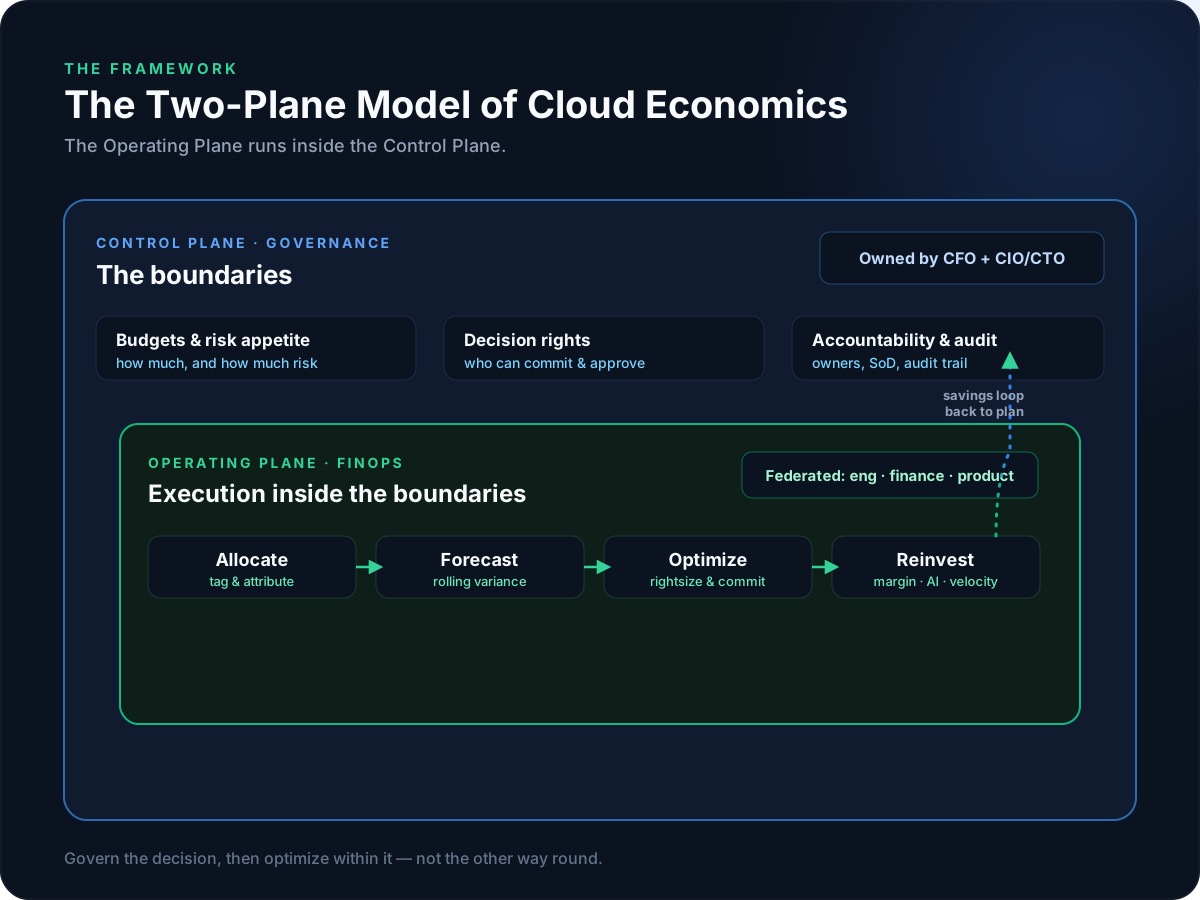
The Control Plane is governance. It's where the boundaries live. Budgets and risk appetite. Decision rights: who can commit spend, approve an architecture, sign off on a three-year commitment. Accountability: named budget owners, segregation of duties, an audit trail that survives a board question. This plane belongs to the CFO and the CIO or CTO, jointly. Its KPIs are cloud cost governance KPIs: budget adherence, policy compliance, chargeback accuracy, approval latency, commitment and concentration risk.
The Operating Plane is FinOps. It's where the work happens, inside those boundaries. Allocate the cloud spend. Forecast it. Find the savings through everyday cloud cost optimization. Reinvest them. This plane is federated and fast, running at the level of workloads, teams, cloud usage, and the underlying cloud resources. Its KPIs are operational: allocated-spend coverage, forecast variance, unit cost, savings-plan utilization, anomaly response time.
The rule that makes the model work is the relationship between them: the Operating Plane runs inside the Control Plane. You cannot optimize your way out of a boundary that was never set. And a boundary nobody actively operates against is just a slide in a deck. The two fail in opposite directions when you build only one.
This is also where the CFO's actual job comes into focus. It isn't to run cloud cost optimization personally. Finance leaders who try to chase rightsizing recommendations themselves are working the wrong plane. The CFO owns the Control Plane: the mandate, the decision rights, the risk limits. Then they fund and empower the people who run the Operating Plane. Set the boundaries well and you make cloud spending governable. Only then is it worth making them optimal. That order matters more than any single tool you buy.
FinOps vs. cloud financial governance, side by side
| Attribute | FinOps (Operating Plane) | Cloud financial governance (Control Plane) |
|---|---|---|
| Primary purpose | Maximize business value through shared accountability and continuous decisions | Keep cloud costs predictable, compliant, and aligned to policy and budget |
| Core question | How do teams optimize, allocate, and forecast? | What controls and rights govern those decisions? |
| Scope | Operational and cultural; cloud-first, now SaaS, licensing, AI, data | Structural and policy-led; finance, risk, compliance, access, procurement |
| Ownership | Federated: central team plus engineering, finance, product, procurement | More centralized: CCOE, finance governance, architecture, security |
| Typical processes | Allocation, showback/chargeback, forecasting, anomaly response, rightsizing, commitments | Policy, permissions, thresholds, audit trails, provider governance, segregation of duties |
| Typical KPIs | Allocated-spend coverage, forecast variance, unit cost, savings-plan utilization, anomaly MTTR | Budget adherence, policy compliance, chargeback accuracy, approval latency, concentration risk |
| Characteristic outcome | Faster, better cost/value trade-offs and reinvestable savings | Predictability, control, accountability, fewer surprises |
Read the table by plane and the Two-Plane Model falls out of it. The left column is everything you do inside the boundaries — the live work of cloud cost optimization and allocation. The right column is the boundaries that keep cloud spending predictable.
How CFOs should actually read the debate
Cloud cost governance forces a handful of design choices, and a few of them tend to get decided badly because they're treated as maturity milestones rather than choices at all.
Showback versus chargeback is one of them. There's a persistent belief that chargeback is the grown-up option and showback is what you do until you're ready. The FinOps Foundation rejects that outright — neither is inherently more mature. Showback gives a team cost visibility into the cloud spend it consumed while those costs stay in a central budget. Chargeback pushes that cost onto a business unit's P&L. Microsoft's guidance adds a detail finance leaders sometimes miss: allocation supports internal chargeback but doesn't change the actual invoice. The accounting still has to happen inside your company, with your ledgers and your disputes. If your tagging and allocation quality are shaky, chargeback-first is how you manufacture distrust. Showback-first builds the cost visibility and the accountability before any money crosses a ledger.
Risk and compliance are quietly pulling cloud cost governance toward the CFO's desk. Under the EU's Digital Operational Resilience Act, regulators designated AWS, Google Cloud, and Microsoft as critical third-party providers for the financial sector in late 2025 (Reuters), handing authorities a stronger supervisory role over cloud resilience. You may not be a bank. The direction of travel is still unmistakable: vendor concentration, operational resilience, and auditable controls over your cloud resources are migrating from the engineering org chart toward finance.
The expert voices converge on the same point from different starts. The FinOps Foundation insists FinOps is "not just minimizing the bill." AWS strategist Mark Schwartz says governance has to "control, and at the same time, enable." Microsoft warns that rigid policy stifles innovation. Gartner's Randeep Rathindran tells CFOs to drive "technology investment discipline" alongside CIOs. They circle the same theme: balancing control, speed, and value, not chasing cost visibility for its own sake.
Which is why the criticisms of both practices deserve a hearing, because both are often fair. FinOps goes wrong when it becomes reactive, tool-led, or a polite word for austerity — the Foundation specifically warns against blunt targets like "cut cloud costs by 50%." Governance goes wrong when it hardens into an approval bureaucracy that slows the teams cloud was supposed to free. We'd argue the strongest position is the unglamorous one in the middle: FinOps is healthiest when cloud cost optimization isn't a euphemism for cost-cutting, and governance is healthiest when it isn't a euphemism for sign-offs. Reject both failure modes on purpose.
A practical roadmap: 0 to 18 months
This is advisory, written for a general organization with meaningful cloud usage. A heavily regulated firm will need more; a small one, less. The sequence is deliberate, and it draws on the FinOps Foundation's crawl-walk-run guidance and the hyperscalers' cloud cost governance frameworks.
| Phase | Timeline | Objective | Accountable | Core deliverables | KPIs |
|---|---|---|---|---|---|
| Establish | 0–3 mo | Executive mandate and governance baseline | CFO + CIO/CTO, FinOps lead, FP&A, security | RACI, policy charter, account/project hierarchy, budget ownership, tagging standard | % spend with an owner; % spend allocable; budget owners assigned |
| Operationalize | 3–6 mo | Cost visibility, showback, forecasting, anomalies | FinOps lead, engineering managers, finance partner | Normalized billing model, showback dashboards, budget alerts, first forecast, anomaly process | Forecast variance; % under showback; anomaly MTTR |
| Govern at scale | 6–12 mo | Chargeback where justified, automated controls | CFO/FP&A, controller, procurement, platform/security | Chargeback rules, commitment governance, policy-as-code, architecture cost gates | Chargeback accuracy; commitment utilization; budget-overrun rate |
| Optimize for value | 12–18 mo | Shift left into product, AI, unit economics | Product finance, engineering leadership, AI/platform leads | Unit-cost models, pre-deployment estimates, AI spend attribution, reinvestment governance | Cost per product/customer; % AI spend allocated; margin impact |
The order isn't arbitrary. Structure the cloud spend before you try to optimize it. Jumping straight to chargeback or large commitment purchases without solid allocation and a trustworthy forecast doesn't produce savings. It produces arguments — and then quiet resistance from the product teams whose P&L just got charged for numbers they don't believe. Real cloud cost management earns its credibility from clean data, not from how aggressively you reallocate the bill.
Recommendations
Treat FinOps as the execution engine of cloud cost governance, not a competing program. Give the CFO and CIO/CTO joint sponsorship of the Control Plane. Make the FinOps lead accountable for the operating cadence that keeps cloud spending under control across engineering, finance, product, and procurement.
Start with showback unless your allocation quality is already strong. It builds behavioral accountability and basic cost visibility without triggering ledger disputes you're not ready to win.
Normalize your billing data early. Make FOCUS part of your target architecture: it's the open billing-data standard now backed by every major cloud as of the 1.3 release in late 2025 (Linux Foundation). Trustworthy chargeback, forecasting, and board reporting all sit on top of a clean model of your cloud spend. Skip this and the rest of your cloud financial management wobbles.
Make forecasting a rolling process, not an annual ritual. Cloud spending is variable by nature. Review forecast variance monthly and commitment utilization weekly. For most organizations, reducing forecast error and assigning real budget ownership beats chasing a heroic savings headline.
Move FinOps left. The next frontier in cloud cost optimization isn't squeezing another two percent out of last month's bill. It's influencing design, the placement of cloud resources, commitment structure, and AI operating choices before the cost lands. Insist that new AI initiatives, major architecture changes, and big commitments pass a light cost-and-value review before approval.
Use native tools first, then add third-party platforms where complexity earns it. The native cloud cost management suites from AWS, Azure, and Google are far stronger than they were two years ago. Reach for a third-party platform when you genuinely need deeper multicloud visibility into cloud spend, better shared-cost or container attribution, or more serious scenario modeling. Let the tool follow the maturity, never the reverse.
Measure the program by outcomes, not gross savings. The KPI set CFOs should defend links cloud economics to unit cost, forecast accuracy, allocation quality, commitment efficiency, and reinvestment. Savings still matter. What matters more is showing where they went: into margin, into AI funding, into resilience, into product velocity. That is what turns cloud financial management from a reporting chore into a board-level capability.
Frequently asked questions
Is cloud financial governance the same as FinOps? No. Governance is the control model — the boundaries, policies, and decision rights. FinOps is the operating model that executes within those boundaries, including the day-to-day cloud cost optimization. They're complementary layers, not synonyms.
Does FinOps replace cloud governance? No. FinOps usually sits inside a broader cloud financial governance architecture. It runs the day-to-day decisions about cloud spend; governance defines the rules those decisions follow.
Which should we implement first? Establish the cloud cost governance mandate and an allocation baseline first, then operationalize FinOps and cloud cost management on top of it. Tools come after maturity, not before.
Should we start with showback or chargeback? Showback first if your tagging and allocation quality are weak. It builds cost visibility and accountability without moving costs across ledgers, which prevents disputes you're not yet equipped to resolve.
Who owns cloud financial governance — finance or engineering? Both. It works best under joint CFO and CIO/CTO sponsorship, with a FinOps lead accountable for the operating cadence across teams.
How does AI spending change this? AI is now core scope (98% of organizations manage it, per the FinOps Foundation's 2026 survey), and it's often the least-governed slice of cloud spending. That raises the value of a strong Control Plane, not just sharper cloud cost optimization.
What is FOCUS and do we need it? FOCUS is an open billing-data standard now supported by all major clouds. It normalizes messy provider billing into one schema so your cloud spend is comparable across providers, giving you consistent cost visibility across your cloud usage, and it's the recommended medium-term data foundation for reporting, allocation, and forecasting.
Sources
- FinOps Foundation — What is FinOps? (2026); State of FinOps 2026; Adopting FinOps: Pitfalls to Avoid.
- FOCUS / Linux Foundation — FOCUS 1.3 vendor-support announcement (Dec 2025).
- AWS — Cloud Financial Management and Cloud Governance guidance.
- Microsoft — What is FinOps?, Cost Management overview, Cloud Adoption Framework.
- Google Cloud — Cost Management and FinOps Hub.
- IDC — Global Public Cloud Spending to Surpass $1 Trillion in 2026.
- Synergy Research Group — Cloud Market Run Rate, Q1 2026.
- Gartner — CFO technology-budget survey, 2025.
- Flexera — 2026 State of the Cloud.
- Eurostat — Cloud computing use by enterprises, 2025 data.
- Azul — CFO Cloud Cost Optimization Report (Apr 2026).
- Reuters — EU designates critical third-party cloud providers under DORA (Nov 2025).