Executive Summary
AI spend governance is the discipline of making AI expenditure visible, attributable, forecastable, policy-bound, and decision-relevant across the whole AI lifecycle — experimentation, training, inference, data pipelines, platform operations, third-party model and API usage, and the people and compliance costs that ride alongside.
That is more than a tooling upgrade. The FinOps Foundation now treats AI as its own technology category, because AI spending is more granular, more volatile, more cross-functional, and far more scrutinized than the cloud bills finance learned to manage. The honest way to describe it: FinOps is graduating from cloud cost management to technology value management, and AI is the reason.
For a CFO, the job comes down to four questions. What are we spending? Who is spending it? What is it creating? And what guardrails apply before any of it scales? Answer those four, in that order, and you have governance. Skip them and you have a stack of invoices.
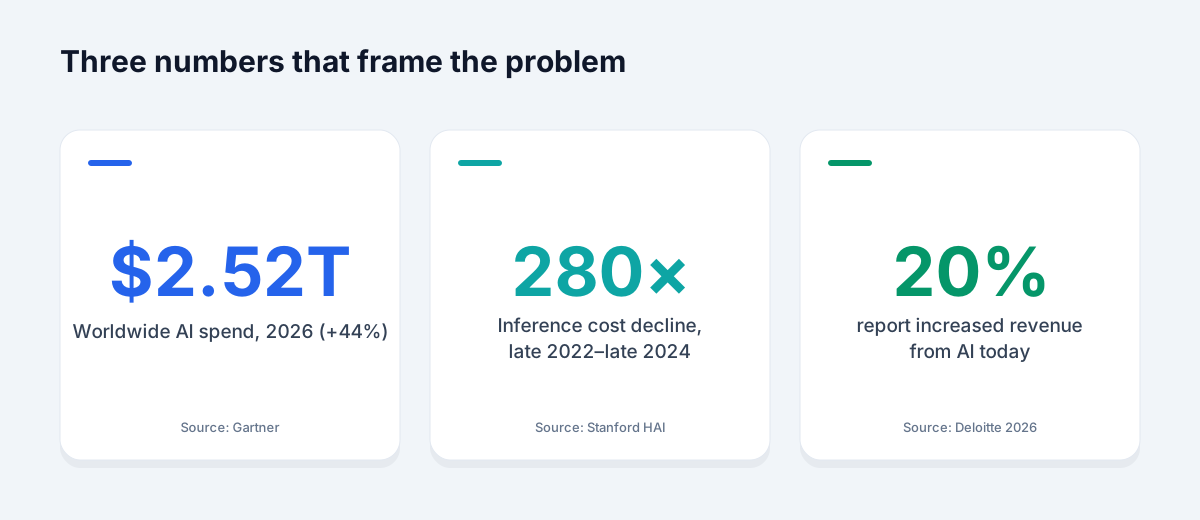
The market makes the urgency hard to argue with. Gartner forecasts roughly $2.52 trillion of worldwide AI spending in 2026, up 44% on 2025, and about $3.34 trillion in 2027, most of it infrastructure. Numbers at that altitude don't get governed at month-end. They get governed at the architecture review, the procurement table, and the funding gate.
So the practical conclusion of this piece is simple, and it runs against how most teams operate today: AI spend governance is a stage-gated operating model, not a finance dashboard. Build ownership, unified data, incremental funding, and value KPIs early. Or wait for the invoice to tell you the spend already got away.
In one sentence: AI spend governance makes AI expenditure visible, attributable, forecastable, and policy-bound before it scales — so finance steers the decision, not just the report.
What AI Spend Governance Actually Is
Start with the working definition the FinOps Foundation has converged on: the financial, technical, and policy controls used to align AI consumption, investment, and business value, both before and after the spend happens. The new meters it names are telling. Cost per token. GPU scarcity and quotas. Tagging and GPU allocation. None of those existed in the cloud-cost playbook five years ago.
The scope is wider than most finance teams assume, because most teams anchor on the model-API bill. That bill is the visible tip. Underneath it sit at least six spend domains:
- Model training — bounded but spiky; usually stage-gated by the run.
- Model inference — variable, demand-driven, the recurring one.
- Data and storage — the enabling layer for retrieval, datasets, compliance.
- AI platform and MLOps tooling — recurring overhead that hides inside "software."
- Supporting cloud infrastructure — the hosting the AI actually runs on.
- People and process — engineers, governance, compliance, review.
Google Cloud's own TCO guidance decomposes enterprise AI cost along almost identical lines — model serving, training and tuning, hosting, training-data and adapter storage, application-layer services, and operational support. When the hyperscaler's cost model and the FinOps standards body land in the same place, that's the boundary of what a credible program has to cover.
Two distinctions trip finance teams up, so name them early.
AI spend governance is not responsible-AI governance. They touch, through risk, privacy, and compliance approvals, but one governs money and the other governs model behavior. Conflate them and the budget conversation gets hijacked by the ethics conversation, and neither gets done.
And it is not cloud cost management with new labels. Azure's own Foundry documentation makes the point against itself: the AI-platform costs it reports are a subset of total application cost, and have to be reconciled with the rest of the stack. The discipline sits in the gap between financial control, platform engineering, and enterprise risk. No single one of those functions owns it — which is exactly why, in most organizations, no one does.
Why AI Breaks Traditional FinOps
The FinOps Foundation's 2026 State of FinOps is blunt about the shift: FinOps is no longer just cloud cost management. Teams are pulling new domains into scope — AI spend (31%), labor (28%), licensed software (24%). AI isn't a sidecar to the discipline. It's bending the discipline's boundary outward.
Plenty carries over. Showback, chargeback, budgeting, forecasting, anomaly detection, commitment management, KPI benchmarking — all still apply. So does FOCUS, the FinOps Open Cost and Usage Specification, which gives finance a vendor-neutral schema across AI, cloud, SaaS, and data center. AWS, Microsoft, and Google all now advertise FOCUS support in some form. That matters more than it sounds, because AI consumption keeps crossing provider lines and finance needs one set of semantics to allocate and forecast against.
The break is in what's genuinely new. Traditional cloud finance optimized infrastructure SKUs on a periodic cycle. AI introduces token billing, per-request and per-character meters, model-routing choices, rapid model-version churn, opaque bundled services, and provisioned throughput you pay for whether you use it or not. The Foundation flags the predictable failure points: poor visibility into AI usage, weak allocation to business units, and ROI that's hard to measure when the investment is still exploratory.
Here's the insight a CFO should carry into every architecture review. AI cost doesn't follow one curve. Training is bounded but spiky, capped by the run and the hardware you provisioned. Inference is variable and demand-driven, and it's the one that quietly overruns, because it scales with usage and spikes with traffic. Data and storage enable everything but rarely top the bill. Tooling is steady overhead. Labor is material and badly standardized in any public dataset. Govern them as one line item and you'll mis-manage all of them.
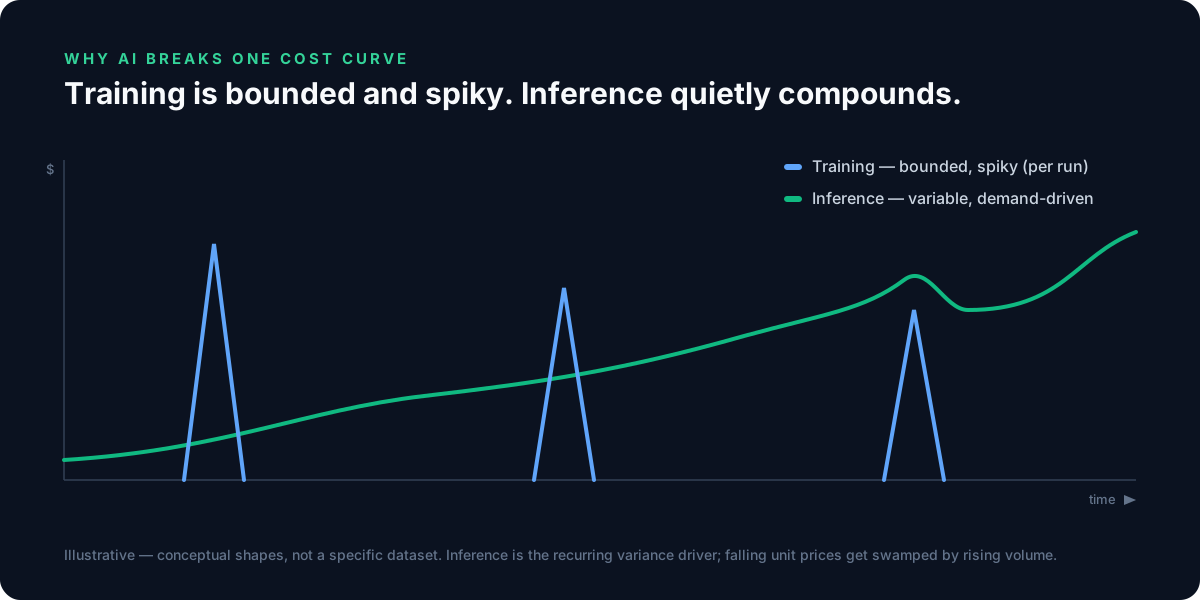
This is where the model comes in.
The Decision-Control Plane for AI Spend
The core argument of this piece is that AI economics are decided long before the invoice — in architecture, in product scoping, in procurement. Routing a workload to a cheaper model, capping output tokens, caching a hot path, negotiating provisioned capacity: each of those is a financial decision dressed as an engineering or sourcing one. Govern those decisions and the bill takes care of itself. Govern the bill and you're auditing the past.
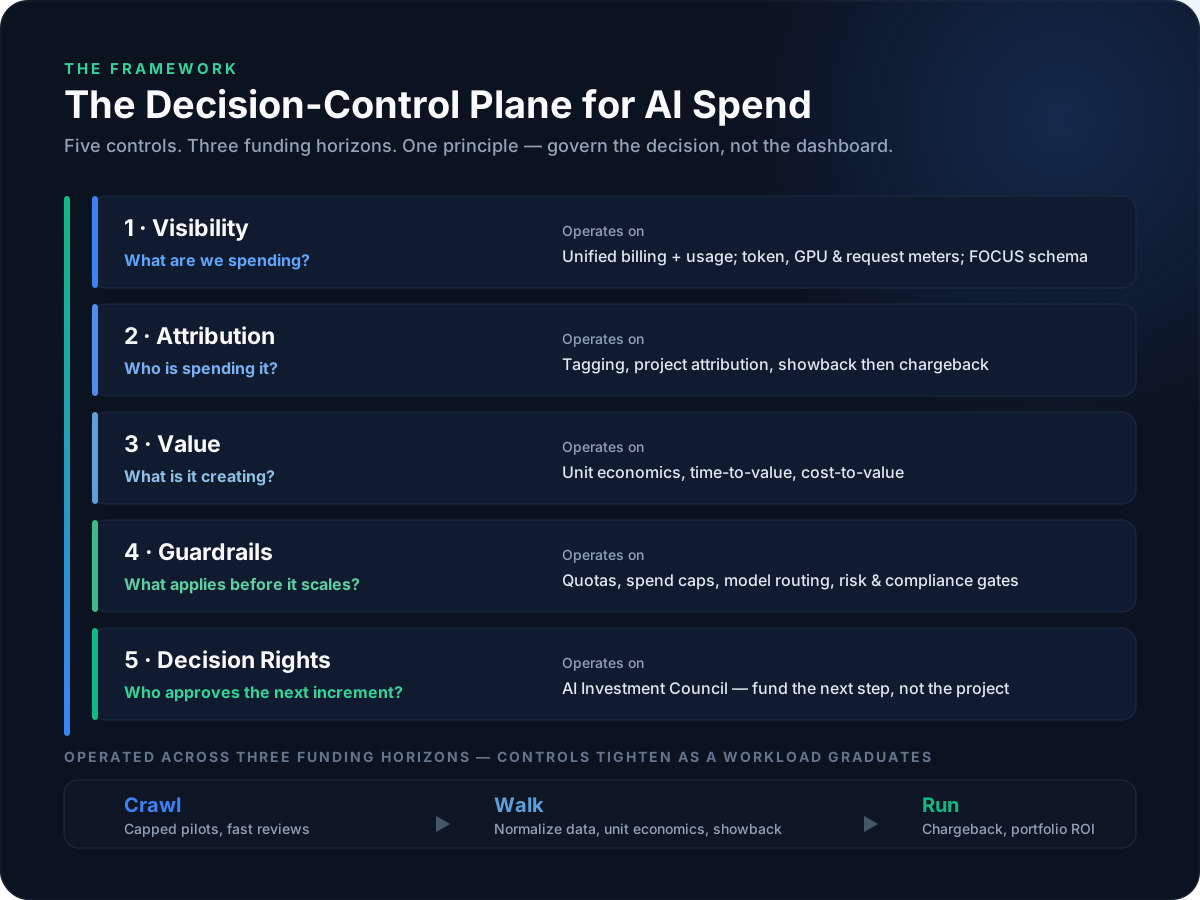
So the frame is govern left — move financial control to the point of decision. The plane has five controls, each tied to a question a CFO has to be able to answer out loud:
| Control | The question it answers | What it operates on |
|---|---|---|
| Visibility | What are we spending? | Unified billing + usage; token, GPU, and request meters |
| Attribution | Who is spending it? | Tagging, project attribution, showback → chargeback |
| Value | What is it creating? | Unit economics, time-to-value, cost-to-value |
| Guardrails | What applies before it scales? | Quotas, spend caps, model routing, risk/compliance gates |
| Decision Rights | Who approves the next increment? | The AI Investment Council; fund the next step, not the project |
And it runs across three funding horizons (Crawl, Walk, Run), so the controls tighten as a workload graduates from pilot to production. That's the whole model: five controls, three horizons, one principle. Decision control over cost optimization.
The Numbers a CFO Should Actually Quote
Before quoting any AI market figure, get the taxonomy discipline right, because the headline numbers are not comparable. Gartner's worldwide AI lens is the broadest. IDC's enterprise-AI-solutions forecast is narrower. IDC's AI-infrastructure tracker is narrower still. Stack them in one slide without that caveat and you'll lose the room the moment someone who knows the data is in it.
With that said, the direction is unambiguous. Gartner puts worldwide AI spending near $2.52 trillion in 2026 and $3.34 trillion in 2027. The 2026 mix is infrastructure-heavy: about $1.37 trillion infrastructure, $589 billion services, $452 billion software. Inside software, Gartner breaks out AI platforms for data science and machine learning ($31.1B), AI models ($26.4B), AI application-development platforms ($8.4B), and AI data ($3.1B). Gartner's own caution is worth repeating to any team building a single ROI model: AI doesn't follow one cost curve, because infrastructure, services, and software each move at their own speed.
IDC tells the same story from a tighter frame: enterprise AI solutions at $307 billion in 2025 rising to $632 billion in 2028; AI infrastructure alone at $318 billion in 2025, $487 billion in 2026, and past $1 trillion by 2029. For finance leaders running more than one geography, the regional curves matter too — IDC sees Europe reaching $290 billion by 2029 (33.7% CAGR) and Asia/Pacific excluding Japan and China climbing from $73 billion in 2024 to $370 billion in 2029 (38.4% CAGR). One detail from IDC's Q4 2025 infrastructure data is a useful reality check on where the money actually goes: storage was just 2.4% of AI-infrastructure spend. Servers dominate. Storage, for all the attention datasets get, is rarely the top direct cost.
Can you split AI spend cleanly into training, inference, data, tooling, and people across the whole enterprise? Honestly, no — public data won't support that precision. Here's what the evidence does support, and what each row means for governance:
| Spend category | Best available public evidence | What it means for governance |
|---|---|---|
| Model training | Stanford HAI cites estimated training-compute costs near $78M for GPT-4 and $191M for Gemini Ultra; FinOps defines a training-efficiency KPI as training cost ÷ performance. | High-stakes but episodic. Govern it at the funding gate, not continuously. |
| Inference | Google's TCO example: ~100k chatbot interactions/day on Gemini 1.5 Flash ≈ $337/month. Stanford HAI: GPT-3.5-level inference cost fell >280× between late 2022 and late 2024. | The recurring variance driver. Falling unit prices get swamped by rising volume. |
| Data storage | Google's example puts training-data and adapter storage under $1/month for a moderate case; IDC: 2.4% of infra spend (Q4 2025). | Matters for compliance and retrieval; rarely the headline cost. |
| MLOps / tooling | Gartner: $31.1B (DS/ML platforms) + $8.4B (app-dev platforms) in 2026. | Real recurring spend. Don't let it hide inside "software." |
| Models / data products | Gartner: $26.4B (AI models) + $3.1B (AI data) in 2026. | Third-party model commitments deserve the rigor you give cloud commitments. |
| Personnel | Global splits unspecified in public data. PwC: AI-skilled workers command a 56% wage premium; FinOps teams now fold labor into scope (28%). | Material but uncharted publicly. Track it explicitly in your own TCO. |
The trend underneath all of this: AI is moving from exploratory budgets to embedded ones. IDC calls it "essential to business operations." Once spend is embedded across products and teams, it stops being a category you can govern centrally after the fact — which is the whole case for moving left.
Applying the Five Controls
A framework earns its keep when it survives contact with a real budget. Here's what good looks like for each control.
Visibility. Unify billing and usage into one place, and instrument the meters that actually drive AI cost (tokens, requests, GPU-hours), not just SKU totals. FOCUS is becoming the shared syntax for this, with all three major clouds exposing it at differing levels of conformance. You don't need perfect coverage on day one. You need one schema everyone trusts.
Attribution. Every workload should carry the same dimensions: business unit, project, model, environment, cost center, data sensitivity, expected value metric. The native hooks exist now — Azure Foundry's project-level attribution, Bedrock's IAM- and user-based cost allocation, tagging and budget alerts across the board. Start with showback for everything. Move to chargeback where your accounting policy supports it, not before. Premature chargeback breeds gaming, not accountability.
Value. This is where AI governance separates from cloud governance. Stop reporting spend alone. Report unit economics: cost per token, cost per inference, GPU and TPU utilization, training-cost efficiency, and time-to-value. Then add a value metric per workload — cost-per-resolved-ticket, time-to-close, satisfaction-per-dollar. A monthly spend chart tells a CFO the number went up. A cost-per-outcome trend tells them whether that was good.
Guardrails. High-variance workloads, inference mostly, need hard spend caps, quotas, caching, right-sizing, and routing policy before they go live. And compliance belongs here too, as a budgeted cost driver rather than overhead. The EU AI Act imposes real obligations on providers and deployers of high-risk systems: risk management, logging, human oversight, documentation. KPMG and the University of Melbourne find 54% of people wary of trusting AI and 70% wanting regulation — and four in five more willing to trust AI when assurance mechanisms exist. Assurance has a price. Budget it, don't bolt it on.
Decision Rights. The decision body is an AI Investment Council — the Foundation's recommendation, and the part most organizations skip. Cross-functional membership (product, AI and platform leads, architecture, infrastructure, security and risk, finance, FinOps, procurement), chaired by a senior executive. Its job isn't to approve everything. It reviews incremental funding requests and pilot-to-scale transitions, compares spend against expectations, and funds the next step rather than the whole project.
A warning on this last control, because it's where governance most often goes wrong. Arrive as a centralized veto and you'll kill the experimentation that makes AI worth funding. The product teams in the State of FinOps data are already pushing back — some are deliberately limiting guardrails to protect speed. The answer isn't more approvals. It's better stage gates: small, frequent reviews and hard caps on the volatile workloads, so pilots can run fast without quietly becoming permanent cost centers.
The Roadmap: Crawl, Walk, Run
The Foundation's crawl–walk–run model maps cleanly onto a CFO's time horizons, which is more useful than maturity jargon.
Short term (crawl). Write the AI spend taxonomy and the ownership map. Decide what counts as AI spend, who approves it, and which dimensions every workload must carry. Turn on native attribution now — Foundry project attribution, Bedrock cost allocation, tags, budget alerts. Stand up the Investment Council with a monthly cadence and incremental-funding rules. Cap pilot budgets and review them fast.
Medium term (walk). Normalize cost data across providers, ideally on FOCUS-compatible exports or an equivalent internal schema. Graduate from spend reporting to unit economics. Make showback universal; move graduating pilots to chargeback where policy allows. And start managing AI commitments (reserved and provisioned capacity) the same way you already manage cloud commitments.
Long term (run). Treat AI spend as portfolio capital allocation. Every material initiative carries a business case, a risk profile, a model-routing strategy, token and output budgets, and a post-launch review. Build portability where lock-in or sovereignty is a real exposure — Gartner expects 70% of enterprises to weigh digital sovereignty as a top cloud-AI selection criterion by 2029. Fold labor, compliance, and data into full-program TCO even where public benchmarks are thin. The leverage at this stage is upstream: routing, quotas, caching, right-sizing, and procurement terms move the number far more than any month-end optimization review.
The Hard Part: Proving Value
Cost control is the easy half. Value is the half that keeps CFOs honest, and the data says most organizations aren't there yet. One practitioner in the State of FinOps 2026, asked whether AI delivers value, answered plainly: "No one can answer that question yet."
The numbers back the unease. Deloitte's 2026 AI report finds 66% of organizations reporting productivity or efficiency gains and 40% reporting cost reduction — but only 20% reporting increased revenue today, against 74% who hope to get there. PwC sharpens it: roughly 20% of companies are capturing about 74% of AI-driven value, and many of the rest still lack the data foundations to move.
The implication for governance is direct. Monthly spend charts can't carry this weight. You need time-to-value, cost-to-value, and payback measured per initiative — the kind of evidence that lets a council decide whether to fund the next increment or shut a pilot down. That's not optimization. It's the difference between an AI portfolio you can defend to the board and one you can only explain.
FAQ
What is AI spend governance? The financial, technical, and policy controls that make AI expenditure visible, attributable, forecastable, and policy-bound across the full lifecycle — so spend is governed before it scales, not reconciled after the invoice.
How is it different from FinOps or cloud cost management? It's the next scope expansion of FinOps. The mechanics carry over (showback, budgeting, forecasting), but AI adds token billing, demand-driven inference, model-version churn, and harder ROI — which is why the FinOps Foundation treats AI as its own category.
What does AI spend actually include? Six domains: model training, inference, data and storage, MLOps and platform tooling, supporting cloud infrastructure, and people and process. The model-API bill is only the visible part.
Is inference or training the bigger budget risk? Different risks. Training is bounded and spiky — govern it at the funding gate. Inference is variable and demand-driven, and it's the one that quietly overruns as usage grows.
What KPIs should a CFO track? Cost per token, cost per inference, GPU/TPU utilization, training-cost efficiency, and time-to-value — plus a business-value metric per workload. Spend-only charts aren't enough.
Where do we start? Write the spend taxonomy and ownership map, turn on native attribution, and stand up an AI Investment Council with monthly reviews and incremental funding. Taxonomy first, tooling second.
The Takeaway
AI spend governance isn't a reporting problem you can solve with one more dashboard. It's the operating model finance and platform leaders need once AI crosses from pilots into portfolio-scale investment. The organizations that build clear ownership, unified data, stage-gated funding, and value KPIs early will control cost without throttling the learning that justifies the spend. The ones that wait for invoices will find the spend already embedded across too many teams, tools, and vendors to govern cheaply.
That's the case for governing left — for treating the AI cost decision as the control point, not the dashboard. It's also, not coincidentally, the principle a financial control plane like InstantViewAI is built on: decision control over cost optimization, applied to AI before the spend lands.
Sources
- Gartner — Worldwide AI spending forecast (2026/2027); software sub-category splits; digital-sovereignty selection criteria (2029).
- IDC — Enterprise AI solutions forecast; AI infrastructure tracker (Q4 2025); European and Asia/Pacific regional forecasts.
- FinOps Foundation — State of FinOps 2026; FinOps for AI guidance; AI KPI library; crawl–walk–run model; AI Investment Council guidance; FOCUS specification.
- Google Cloud — Enterprise AI TCO guidance and worked example.
- Microsoft — Azure AI Foundry cost-management and project-attribution documentation.
- AWS — Bedrock cost allocation and prescriptive guidance on training vs. inference cost behavior.
- Stanford HAI — AI Index: frontier-model training-cost estimates; inference cost decline.
- Deloitte — 2026 AI report (value realization).
- PwC — AI value capture; AI-skills wage premium.
- KPMG & University of Melbourne — Trust in AI study.
- EU AI Act — Obligations for high-risk AI providers and deployers.